What I Heard About Iraq
 Adapted
by Simon Levy from Eliot Weinberger's London Review Of Books article. Adapted
by Simon Levy from Eliot Weinberger's London Review Of Books article.
Directed by Hannah Eidinow, Designed by Mike Lees
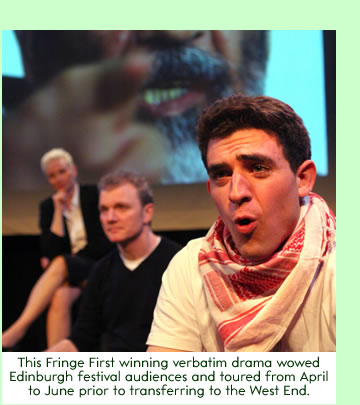
WINNER - Scotsman Fringe First Award 2006
Toured to small and mid-scale UK venues, April
to June 2007
This new drama employs direct quotes
from politicians, military chiefs, soldiers, and Iraqi citizens to reveal
the unfolding
human story
behind the US led invasion of Iraq. In Levy’s words, the play is “neither
fiction nor speculation; it takes audiences into the war and confronts
them with the human drama, the human toll. It is not about history, or
about something going on ‘over there.’” It is about
what’s going on right now, and how people worldwide are (and are
not) reacting to it.
Edinburgh festival 2006 reviews
The
Scotsman - 4 stars– by Joyce McMillan
Of all the verbatim
and documentary shows on this year's Fringe, What I Heard About Iraq
- adapted by Simon Levy from a ground-breaking
London Review of Books article by Eliot Weinberger - must be the
most straightforwardly
news-based, best-organised and most exhilaratingly sure-footed and
hard-hitting.
In
a brief 60 minutes, a team of five British and American actors lead
us through a roughly chronological sequence of statements about Iraq
made by western leaders over the last half-decade, each one prefaced
with the
devastating, distancing words, "I heard".
The basic thesis
of the show is that our leaders have had no consistent view of Iraq
at all, have changed their story repeatedly to fit their
hidden policy agendas, and have only been able to get away with it because
of the chronic amnesia of our rolling news culture; and it makes its
case with devastating force, marshalling statement after statement to
demonstrate
the leaders' chilling capacity both to lie, and then to lie about the
fact that they have lied.
It would be wrong, though, despite the strong
factual basis of this show, to ignore the unobtrusive artistry of Hannah
Eidinow's direction,
the
huge, organised energy of the performances and the heart-stopping,
tragic beauty of the visual images of war-torn Iraq used as a backdrop
to the
show. This is beautifully designed, beautifully performed, powerfully
directed; and it strikes a magnificent blow in the struggle of memory
against forgetting which, as Milan Kundera once said, is the struggle
of man against power.
The Guardian – 4 stars - by Lyn Gardner
In
2001, Colin Powell and Condoleezza Rice announced that Saddam Hussein
had not developed any significant weapons of mass destruction.
Within
a year, members of the Bush administration were announcing that
Saddam and Iraq were in possession of the most lethal weapons ever
developed, while President Bush was claiming "you cannot distinguish
between al-Qaida and Hussein". A year later, the invasion of Iraq
began. How did Iraq go from being no threat at all, to one that
demanded
all the US's military might in the space of just two years?
What
I Heard About Iraq is a theatrical collage based on Eliot Weinberger's
London Review of Books article which uses nothing
but the documented
statements of politicians, soldiers and civilians to create
a narrative dealing with
the march to war and the continued occupation of Iraq.
Using
only fully verifiable facts and quotes, it doesn't just raise one
question, it makes you question just about everything
you've
heard and
read. It tells you things that you thought you already knew,
and reminds you of things that you once thought but had forgotten.
And, in the
case of Donald Rumsfeld, it quotes him saying things he later
claims never
to have said at all.
It's like watching someone trying to dig
themselves out of a deep hole and only succeeding in covering themselves
with
sand. Played
on an almost
bare stage but for five glass boxes filled with bullets
or discarded newspapers and magazines which the actors use as
seats, and incorporating
powerful
images of everyday life in war-devastated Iraq, the show
is staged with snappy simplicity by Hannah Eidinow.
Inevitably, it's
quite static, and although you could argue that this is something
that could perhaps be read just as
well as staged,
the
use of actors' voices and body language lends a real immediacy,
and heightens
the clever juxtapositions of statements and facts. However
many newspapers you've read, this is a show that joins
up the dots
in the narrative
and reminds you that, in a world where it's increasingly
difficult to know
what to believe, you can't just take words at face value
but must learn to read between the lines.
The Times – by Robert Dawson-Scott
What I
Heard About Iraq started as a newspaper column. It simply relates
what people – from President Bush to Iraqi civilians – have
said about Iraq since 9/11. It has the effect of highlighting the politicians’ duplicity,
in many cases completely contradicting themselves, and the bitterness
of the Iraqis. Hannah Eidinow directs her cast with discipline and
restraint. Let the words speak for themselves, and they do. It is
still not a play
but as a piece of propaganda it is undeniably effective.
Evening Standard – 4 stars – by
Veronica Lee
What I Heard About Iraq is that rare thing, an impassioned
and dynamic piece of verbatim theatre, using the words of Bush, Blair,
Rumsfeld,
Rice, serving soldiers and civilians caught in the war zone.
It's
highly partial, but when the world's most powerful politicians obsfucate,
directly contradict themselves and downright lie over
numbers of casualties
and weapons of mass destruction, it's hard not to be. The talented
cast of five play multiple roles and are superbly directed by
Hannah Eidinow.
Metro – 4 stars – by
Claire Allfree
Why bother writing a play about the invasion of
Iraq when you can let the facts speak for themselves? That notion
is certainly justified
by
this stark, powerful piece, that dramatises Eliot Weinberger's
blog and book. What I Heard About Iraq is a simple collation
of stats,
facts and
official statements made by US and UK Governments on the subject
of Iraq from the past five years.
That lies have been told
is an all too familiar truism here. Yet with the words on the subject
removed from their original
context
and presented
in a coherent, chronological order, the extent to which
Blair and Bush have manipulated the truth in the name of justifying
a catastrophic
invasion takes on a new urgency. Five actors take it in
turn against a backdrop
of video footage to recite various statements and testimonies.
Be it
Colin Powell's declaration in 2001 that Saddam possessed
no WMD, the anxious
US soldier told by his priest that it was OK to kill others
if it was in the name of his government or Donald Rumsfeld's
bovine
responses
to the casualty pile up – war is untidy, apparently.
The
juxtaposition of flagrant contradictions is deeply discomforting.
These include George Bush's declaration of America as a
nation of peace contrasted with the number of bullets bought
by the
military last year – 58
for every inhabitant of Iraq.
That the cast continually emphasise
the mantra 'I heard' makes it clear that, as well as the
rising death toll on
all sides,
an equally
important
casualty of this sorry affair has been language itself.
Propaganda, spin, hypocrisy, rhetoric: it's all here in
its brazen, blazing
glory from our
democratically elected governments. This angry, committed
piece makes for sober listening.
Edinburgh Evening News – 4 stars – by
Thom Dibdin
GRIPPING and thrilling political theatre has been a hallmark
of this year's Fringe. Plays such as Black Watch and
Petrol Jesus
Nightmare
have given
the soldier's point of view of war in the Middle East.
There
is another, moving, side to this too. Plays told from the point of
view of innocents caught up in the
conflicts. Ironically, the most
powerful of these do not dramatise events, but use
theatre as a medium to focus on the actual words of those involved.
Changing attitudes over the past 16 years are the subject of What I
Heard About
Iraq. This is a compilation
of public
statements
made by
Western
leaders about Iraq.
From the dismissal of Sadam
as a threat in 1992, to his demonisation after the attacks on the
World Trade
Centre.
From the promises
and predictions made about the Allied attack
on Iraq, to the realities of what has actually
happened.
The power of this lies in hearing different
and conflicting statements next to each other.
Occasionally
they are
made all the more poignant
by the inclusion of something said by someone
in Iraq, whether soldier or
civilian.
There is even dark humour in quotes
from the likes of Arnold Schwarzenegger. What is particularly
chilling is
that it
is up-to-the-minute.
The last lines talk of the car bombs, killings
or abductions which happened
that
morning.
New York Times – by Sarah Lyall
One play that has
been much admired by audiences is Simon Levy’s “What
I Heard About Iraq,” a stark recitation of actual quotations — some
fatuous, some incomprehensible, some terribly sad — from the instigators
of and participants in the Iraq war. The play is less a drama than an
indictment, an exercise in controlled outrage, and the performers are
preaching to the converted. The audiences’ anger
flashes back through its applause at the end.
The
Stage
In what must be the most straightforward
of the many verbatim shows in this year’s
fringe, Eliot Weinberger repeats a series
of statements he has heard
being made about Iraq
since
1992. A cast
of five reports
the statements and, tellingly, who made
them.
Sometimes they use an accent - Sean
Mullin’s
Arnold Schwarzenegger provides a welcome
laugh amidst the enormity
of what else is being
said. Occasionally Lewis Alsamari translates
into Arabic a statement made by
an American politician specifically
for Iraqi consumption. But mostly this
is a
plain list
of things said in
public by politicians.
It should, by rights,
be pretty tedious. Sadly, it is compelling
stuff which forms
in a horribly
dramatic
structure
as the
statements change
over time.
There’s an introduction,
where Iraq is said to be a proven toothless
threat, then
an exposition
when that truth
is refuted.
A long, bloody
climax when reports of how American
and British politicians dealt with that threat
are given,
and a finale, when
the original statements
are
found to have been true after all.
The occasional
back-projected photograph and a set of Perspex boxes containing the
detritus
of
war
add to a
strong piece
of theatre
which finds condemnation
of those responsible through their own
words.
British Theatre Guide – 4 stars – by
Philip Fisher
What I Heard About Iraq is
another, powerful piece about George Bush's War on Terror.
Rather like
Michael Moore's
Fahrenheit
9/11, it takes
verbatim quotes about the war and juxtaposes
those that seem contradictory.
Inevitably
the targets of this docudrama, presented by three men and two women
playing dozens of
roles, are George
Bush,
Donald
Rumsfeld
and Tony
Blair. These are the proven hypocrites
who, the play makes clear, were forced
to eat
earlier words,
primarily
those
justifying
the invasion of Iraq.
Director Hannah
Eidinow keeps the relentless full-on statements flowing
for an hour
and the message
comes through loud
and clear, again and
again. This war is wrong.
While
the politicians' statements and debunking are familiar, as has
been
proved several
times over in
Edinburgh already
this year,
it
is the evidence
from the victims of atrocities
that is most moving. To hear of mass
killings has far
less impact than
the story
of a
single mother
or
son.
Scotsgay – 5 stars – by
Martin Walker
Usually in shows when
reviewing you make notes about the main points
for
future
reference. In this show
I gave
up after
about one minute
such was
the volume of information being
thrown at the audience. The
title says most
of what
you need
to know, 5
actors all taking
on different
roles
who repeat "I heard Donald
Rumsfeld say" or The President
say, or Tony Blair say, or whoever
say.... Presented in this way
and by taking
quotes from different times
the way we were systematically
lied
to from 1991 about Iraq becomes
clear.
If only 10% of the quotes
were accurate
then these murderous bastards
should spend the rest of their
days behind
bars, and I've no reason to
believe only 10% of them were
true. In fact
I remember about 10% of the
quotes and know them to be accurate.
However
the most memorable one came
from an anonymous Iraqi "Saddam
Hussein's greatest crime is
he brought the Americans to
Iraq".
The show ends with a quote
from Lawrence from 2nd Aug
1920 which
shows just
how little some
people
have learnt.
One
of the unexpected
highlights
of this year's Fringe.
BroadwayBaby.com – 4 stars
What I Heard About Iraq is an
adaptation of Eliot Weinberger’s controversial
article, published in 2005.
Hannah Eidinow directs Simon Levy’s
adaptation for its European
premier.
Its strength is that by analysing
the war through the words
of the politicians, Iraqis
and military
personnel
involved,
it connects
to
both the politics
and the human scale of the
conflict.
The actors do not take specific
characters but instead take
it in turns to say ‘what
I heard about Iraq’.
The cast is strong, a well-chosen
mix of Americans, British
and British-Iraqi.
As the quotes move chronologically
from 2001 onwards, a strong
anti-war message emerges
by showing the contradictions
inherent
in the assessment
of threat from
Iraq and justification for
engagement.
The production
avoids becoming static as
it is punctuated
with photos
from the conflict
and parts
where all
5 voices speak
in chorus.
Meg Fraser adds emotion,
often taking the voice of the families
involved,
while Gail
Winar’s deadpan delivery
sends a shiver down the spine.
Comedian Tim Clark’s
powerful performance adds
gravitas, and Sean Mullin
in combat gear is
very effective when
taking on
the voice
of the
American military. Lewis
Alsamari, recently seen
in the film
United 93, particularly
adds to the show with his
simultaneous translation
of some quotes into Arabic.
This
is likely to become one
of the Fringe’s
most talked about shows, and rightly so.
|




